
 Summarize this article with:





Veneers vs Dental Implants: Advantages and Disadvantages
Written by Novin Ariana
A bright, balanced smile can change how you speak, laugh, and feel in photographs. But veneers vs dental implants is not a simple choice between two cosmetic upgrades. They solve very different dental problems: veneers enhance the visible surface of healthy teeth, while implants replace teeth that are missing or cannot be saved.
The right treatment depends on what is happening beneath the smile line. Tooth structure, gum health, bone volume, bite forces, aesthetic goals, and long-term maintenance all matter. A careful clinical assessment should always come before a treatment plan, especially when you are traveling internationally for care.
Anyone weighing options to restore a compromised smile inevitably confronts two dominant pathways: dental veneers and dental implants. Both promise transformation. Neither suits every case. This guide dissects each procedure so that chipped, discolored, or missing teeth no longer dictate how confidently you speak or smile.
Veneers vs Dental Implants: The Core Difference
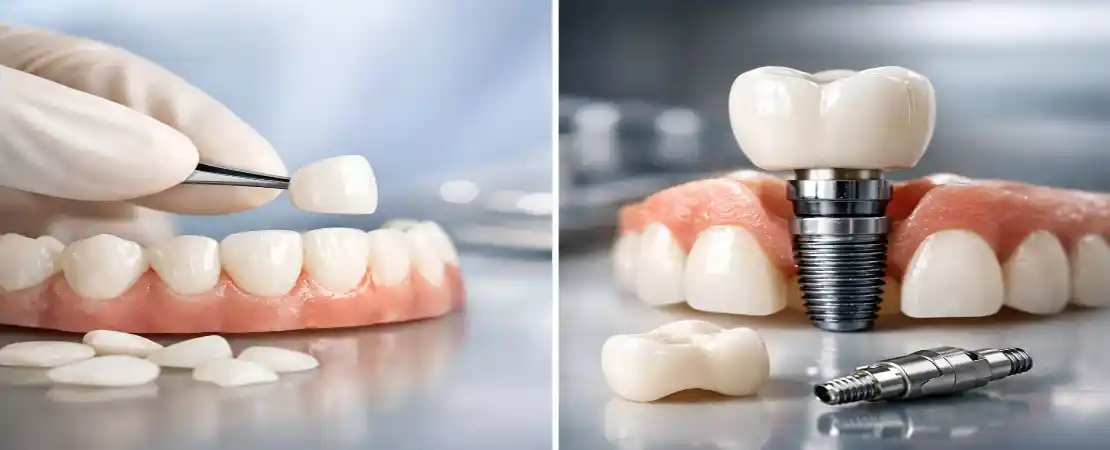
A veneer is a thin, custom-made porcelain or ceramic shell bonded to the front of an existing tooth. It can improve the appearance of teeth affected by staining, small chips, uneven edges, minor gaps, or irregular shape. Because a veneer relies on the natural tooth underneath, that tooth needs to be structurally sound and supported by healthy gums.
A dental implant is a replacement tooth root, usually made from biocompatible titanium or zirconia. It is placed into the jawbone and, after healing, supports a custom crown. An implant is designed for a tooth that is absent, severely damaged, or no longer predictable to restore with other dentistry.
Put simply, veneers refine teeth that are present. Implants replace teeth that are gone. When a tooth has been removed or is fractured below the gum line, a veneer is not an alternative. When a tooth is healthy but visually distracting, an implant would be unnecessarily invasive.
Table of Contents
What Are Dental Implants?
Implants introduce an artificial tooth root—almost always titanium—surgically anchored into the jawbone. A crown is subsequently affixed atop this foundation, replicating both the function and appearance of a natural tooth.
Advantages of Implants
- Natural Function: Implants eat, speak, and smile like biological teeth.
- Longevity: Properly maintained implants can endure a lifetime, offsetting their steep initial price.
- Bone Preservation: Implants provide the jawbone stimulation lost when a natural tooth is extracted, halting the deterioration that otherwise follows.
- Alignment Stability: By filling the gap left behind, implants prevent neighboring teeth from drifting into misalignment.
- Restored Confidence: A complete smile often translates into renewed self-assurance.
- Dietary Freedom: Patients can consume a full range of foods without discomfort, supporting better nutrition.
- Facial Structure Preservation: By halting bone loss, implants help maintain the jaw’s original contour.
- Speech Clarity: Unlike removable dentures, implants eliminate slippage that can distort speech.
- Decay Immunity: The implant material itself cannot develop cavities.
- Bacterial Defense: Implants reduce the pathways through which bacteria threaten adjacent natural teeth.
Drawbacks of Implants
- Surgical Risk: The procedure carries standard surgical hazards—infection, nerve damage, and injury to neighboring structures.
- Extended Recovery: Osseointegration, the fusion of bone to implant, can span several months.
- Substantial Cost: Implants generally exceed veneers in price and are seldom covered by insurance.
- Rejection Possibility: As with any implant, the body may reject the device, necessitating removal.
- Candidacy Restrictions: Insufficient bone density, smoking, or certain chronic conditions can disqualify patients.
- Potential Bone Grafting: Prolonged tooth absence may necessitate a grafting procedure beforehand, adding cost and recovery time.
- Sinus Complications: Upper-jaw implants occasionally interfere with sinus cavities.
- Peri-Implantitis Risk: This gum-and-bone infection surrounding the implant can cause discomfort, halitosis, and, left untreated, implant failure.
- Surgical Variables: Excessive bleeding or anesthesia reactions remain possible complications.
- Age Restrictions: Implants are generally reserved for adults whose jawbone has finished developing.
What Are Dental Veneers?
Veneers are ultra-thin, custom-fabricated shells engineered from tooth-colored materials and bonded directly to the visible surface of a tooth. The result: an altered color, contour, and proportion that yields a markedly enhanced appearance.
Two materials dominate veneer fabrication: composite resin and porcelain.
Porcelain Veneers exhibit superior strength, extended longevity, and heightened resistance to staining. Fabrication typically demands a minimum of two dental appointments and modest enamel reduction.
Composite Resin Veneers can often be completed in a single visit, requiring minimal to no tooth reduction. They cost less upfront but trade durability and stain resistance for that convenience.
Advantages of Veneers
- Conceal Imperfections: Chips, hairline cracks, and discoloration vanish beneath a well-fitted veneer.
- Durability: Porcelain variants function as a near-permanent fix, outlasting natural enamel’s resistance to decay and staining.
- Structural Reinforcement: Veneers lend additional strength to the underlying tooth.
- Efficiency: The entire process typically concludes within two appointments.
- Aesthetic Authenticity: The finished product mimics natural dentition convincingly.
- Stain Resilience: Non-porous construction repels the discoloration that plagues natural enamel.
- Transformative Impact: Veneers remain the single most effective tool for brightening and evening an entire smile.
- Speed Over Orthodontics: Where braces demand months or years, veneers deliver comparable visual results almost immediately.
- Simple Upkeep: Ordinary brushing, flossing, and routine checkups suffice.
Drawbacks of Veneers
- Irreversibility: Enamel removal cannot be undone once the procedure begins.
- Sensitivity Risk: Reduced enamel may leave teeth more reactive to temperature extremes.
- Limited Candidacy: Chronic teeth-grinders or clenchers risk cracking their veneers.
- Collateral Damage: A dislodged or fractured veneer can expose the underlying tooth to decay.
- No Repair Option: Damaged veneers require full replacement rather than patching.
- Fixed Shade: Once bonded, the color cannot be adjusted or whitened.
- Expense: Insurance rarely subsidizes what is classified as an elective, cosmetic procedure.
- Gum Sensitivity: Some patients experience adverse tissue reactions to porcelain.
- Cosmetic Only: Veneers mask problems; they do not remedy underlying oral pathology.
Ready to change how you look and feel?
Get your consultation now — your new self is waiting.
When Veneers May Be the Better Choice
Veneers are often appropriate for patients who want a more harmonious smile without replacing healthy teeth. They are particularly useful when several front teeth have discoloration that does not respond well to whitening , uneven proportions, mild spacing, or worn edges that affect the smile’s symmetry.
The most natural-looking veneer treatment is not about creating the whitest possible smile. It is about selecting a shape, shade, translucency, and length that suit your facial features, skin tone, lips, and personality. A conservative plan may involve only the teeth visible when you smile. Other patients choose a broader smile design for greater balance.
Preparation is usually required. Your dentist may remove a small amount of enamel so the veneer sits naturally rather than looking bulky. This is an irreversible step, so it deserves thoughtful planning and clear communication. Patients who grind or clench their teeth may still be candidates, but they may need a protective night guard and a material choice suited to their bite.
Veneers are not ideal for every concern. Significant decay, active gum disease, large failing fillings, severe crowding, or a tooth with poor structural support should be addressed before cosmetic work begins. Placing a beautiful veneer over an unhealthy foundation can lead to disappointment and avoidable retreatment.
When Dental Implants Make More Sense
An implant is commonly recommended when a tooth is missing or must be extracted because of advanced decay, root fracture, infection, trauma, or extensive structural loss. Beyond restoring the appearance of a gap, an implant crown can help restore chewing function and prevent neighboring teeth from drifting into the empty space.
The jawbone needs adequate volume and quality to hold an implant securely. If bone has shrunk after a tooth was lost, grafting may be advised before or during implant placement. This can add time to the overall process, but it is often an important part of building a stable long-term result.
Implant treatment also requires patience. After placement, the implant needs time to integrate with the bone before receiving its final crown. Some cases allow for a temporary tooth during healing, particularly in the smile zone, but this depends on stability, bite conditions, and the surgeon’s assessment. A responsible team will not promise immediate final teeth when the biology does not support it.
For many patients, the strongest benefit of an implant is that it does not require neighboring healthy teeth to be filed down, as a conventional bridge often does. Still, implants are not maintenance-free. Daily brushing, cleaning around the implant, regular professional reviews, and healthy gums remain essential.
Ready to change how you look and feel?
Get your consultation now — your new self is waiting.
Cost: Look Beyond the Initial Quote
It is understandable to compare treatment costs, especially when considering care abroad. However, the lower-priced option is not always the more economical one if it does not solve the actual problem. A veneer may cost less and require fewer visits than an implant, but it is not suitable for replacing a missing tooth. Conversely, an implant should not be used to replace a tooth that can be predictably preserved with less invasive treatment.
When reviewing a dental package, ask what is included in the written plan. For veneers, this may include digital smile planning, tooth preparation, temporary restorations where needed, the final ceramic veneers, and follow-up adjustments. For implants, clarify whether the price includes imaging, extraction if required, bone grafting, implant placement, abutment, temporary restoration, final crown, and post-treatment reviews.
Transparent planning matters more than a headline price. International patients should also understand whether their care will require one visit or separate treatment stages, and how long each stay is expected to be.
Veneers Versus Implants: Cost, Longevity, and Outcomes
The financial calculus diverges sharply between these two treatments. Veneers demand a smaller upfront investment but may require periodic replacement, inflating cumulative cost over time. Implants front-load expense yet frequently prove more economical across decades due to their exceptional durability.
Cost: Veneers cost less initially but often need renewal; implants demand a heftier initial outlay while rarely requiring replacement.
Longevity: Implants typically endure 25 years or beyond with diligent care, dwarfing the 10-to-15-year lifespan typical of veneers.
Outcomes: Both deliver striking aesthetic results. Implants reconstruct the entire tooth—root through crown—addressing function and form simultaneously. Veneers, by contrast, overlay the tooth’s front surface, elevating appearance without the invasiveness of surgery.
Upkeep: Implants demand the same regimen as natural teeth. Veneers require comparable diligence, plus vigilance against staining agents and abrasive materials that could fracture the shell.
Procedure: Veneers involve a comparatively gentle process, often concluded in two visits with negligible downtime. Implants entail surgery and a substantial healing window.
Oral Health Impact: Implants safeguard jawbone integrity and the structural stability of surrounding teeth. Veneers necessitate minor enamel removal but compensate by adding a protective layer over what remains.
Suitability: Implants suit patients confronting missing teeth or extensive decay. Veneers address milder cosmetic concerns—discoloration, minor chips, or modest gaps.
Insurance: Both procedures are typically classified as cosmetic, meaning coverage is the exception rather than the rule. Verification with your provider remains essential before committing.
Ready to change how you look and feel?
Get your consultation now — your new self is waiting.
Which Option Suits You?
Both veneers and implants can dramatically elevate a smile, yet each carries a distinct calculus of benefits and trade-offs. The right choice hinges on budget, existing dental condition, and desired outcome. A qualified dentist remains indispensable to that determination.
If dissatisfaction with your smile has you hesitant to speak freely, schedule a consultation. A thorough evaluation of your dental condition will clarify which treatment aligns with your goals, and a tailored plan will guide you toward a healthier, more confident smile.


Your Timeline and Travel Plan Matter
Veneers can often be completed within a shorter treatment schedule once oral health is stable. This can make them appealing for patients seeking a cosmetic improvement during a planned visit. Yet careful design should not be rushed. Trial smiles, tooth preparation, laboratory craftsmanship, and bite checks all influence the final result.
Implants frequently involve a longer timeline because healing is part of the treatment. Some patients travel for surgical placement and return later for the final crown. Others may be eligible for a carefully planned immediate temporary solution. The right schedule is individualized, not standardized.
For patients traveling to Istanbul, Novin Ariana Health Clinic coordinates a personalized patient journey around clinical requirements, including consultation support, accommodation arrangements, VIP transfers, and follow-up guidance. The priority should remain the same throughout: a plan that protects your health rather than forcing your dentistry into an inconvenient schedule.
Ready to change how you look and feel?
Get your consultation now — your new self is waiting.
Making the Right Decision for Your Smile
Choosing between veneers and dental implants is not simply a cosmetic decision—it is a clinical one. The most successful outcomes are achieved when treatment preserves healthy tooth structure whenever possible while restoring function when replacement becomes necessary.
Whether your goal is improving the appearance of healthy teeth or replacing missing teeth with a long-term restorative solution, the first step should always be a comprehensive evaluation by an experienced dental team. A personalized treatment plan built on accurate diagnosis, evidence-based dentistry, and your individual smile goals provides the strongest foundation for long-lasting oral health and confidence.
Questions to Ask Before Choosing a Clinic in Turkey
International dental care should feel organized, not uncertain. Before committing, ask who will perform your treatment, what qualifications and specialty experience they have, and what diagnostics are included. You should also understand the material brand or type proposed, the number of appointments required, and whether your plan could change after examination.
It is equally wise to ask how complications, adjustments, or follow-up needs are handled after you return home. Reliable providers communicate clearly about what is included in the quoted price and what may create additional costs, such as grafting, extractions, temporary restorations, or treatment for gum disease.
At Novin Ariana Health Clinic, international patients receive personalized treatment coordination designed around clinical assessment, travel comfort, and long-term support. From multilingual communication and VIP transfers to premium accommodation options and post-treatment guidance, the objective is to make a complex decision feel clear and well supported.
Frequently Asked Questions
Our representatives for all countries are 24/7 available to support you at any time
Implants typically last 25 years or more with proper care, while veneers generally last 10–15 years before needing replacement.
Veneers cost less upfront, but implants often prove more cost-effective long-term due to their durability and reduced need for replacement.
Implants require a surgical procedure and a healing period of several months. Veneers involve no surgery and are typically completed in two visits.
No. Veneers only cover the front surface of an existing tooth. Implants are the appropriate solution for a missing tooth, as they replace the entire tooth structure, root included.
Most insurance providers classify both as cosmetic procedures, meaning neither is typically covered. Confirm coverage details directly with your provider.
Patients who grind or clench their teeth are generally poor candidates, as this habit can crack or chip veneers over time.